Blogometry
  • Home
  • Quotes
  • Statistics

GOP Delegate Count as of March 10, 2016

3/10/2016

0 Comments

 
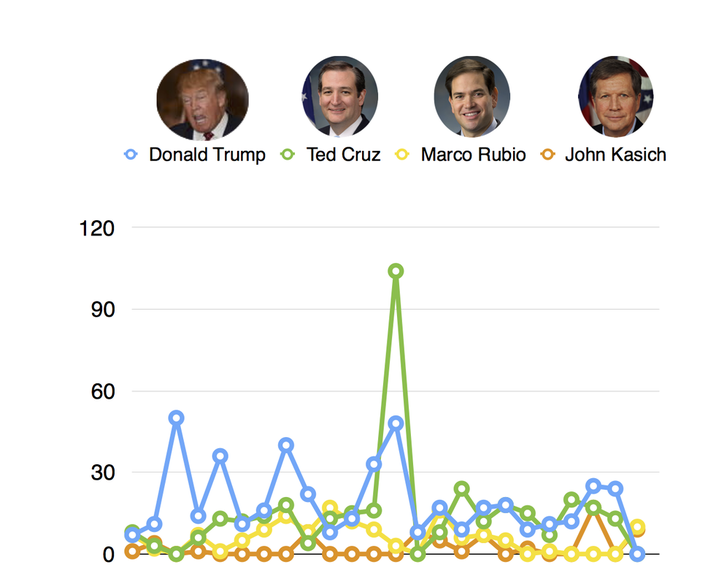
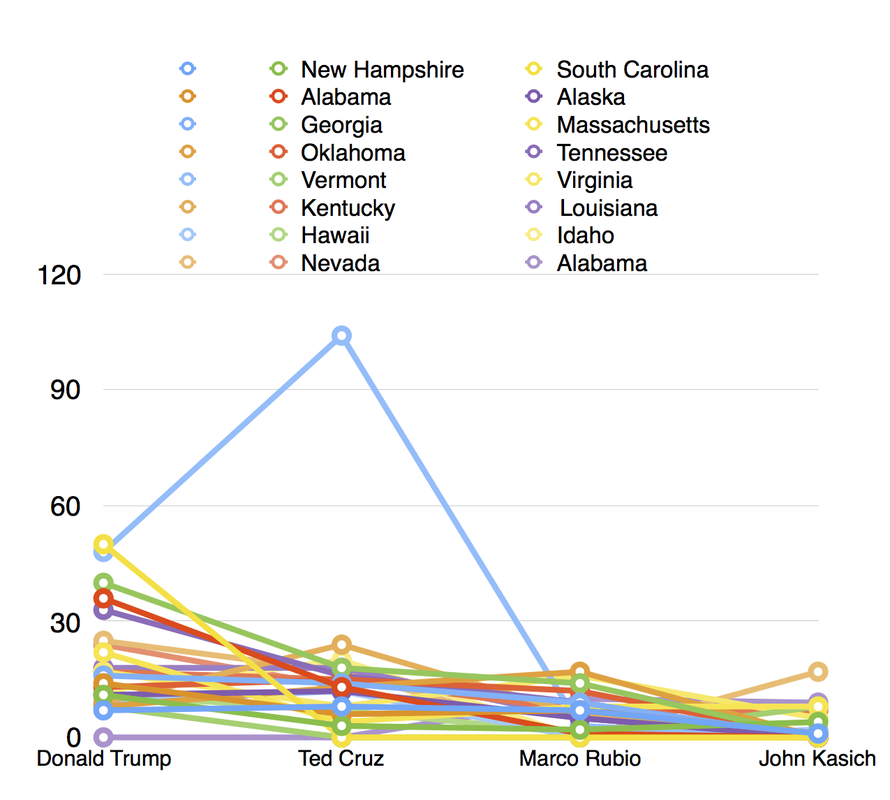
The below graphs show the Republican frontrunner Donald Trump's relative consistency in capturing delegates throughout the primary season thus far. Donald Trump has shown his dominance in the Deep South and has proven effective in gaining evangelical support, much to Senator Ted Cruz's dismay. Additionally, the graphs displayed below show Cruz's reliance on his win in the Texas primary, his home state, and his success in other primaries and caucuses such as Kansas and Oklahoma. However, Cruz is still trailing Trump by a sizable margin and will continue to do so until he discovers a way to regain the support of evangelical voters and begins to appeal to younger Republican voters who tend to be attracted to Trump's populist sentiment. Trailing Cruz by over 200 delegates, Florida Senator Marco Rubio has remained ineffective at gaining momentum in the polls. Rubio, in an attempt to retain the support of the Republican establishment, has lost much of his appeal to the majority of Republican voters. Thus far, Republican voters have shown their resentment for the Republican establishment and have supported candidates who think similarly. Rubio's support from the Republican establishment is exemplified by his win in the Washington, D.C. primary. Due to the concentration of voters who sympathize with the Republican establishment in Washington, D.C, both Rubio and Kasich performed well in the district's primary. Overall, Rubio has not yet found his audience in this election cycle, and if the Republican presidential election continues the way it has been, Rubio may never find that audience. Finally, Ohio Governor John Kasich has also remained ineffective in the recent Republican primaries. Similar to Rubio, Kasich has gained some support from the Republican establishment. However, this support has wavered over the past few weeks due to the Republican establishment's scuffle to elect a candidate that will conform to their agenda while still having the ability to overtake both Trump and Cruz in the polls. Kasich has repeatedly stated his appeal to both Democrats and Republicans, but this election cycle the majority of Republican voters don't want crossover between the two parties; they want a wall.

​ZWG
Picture
Picture

Source: New York Times

0 Comments

Donald Trump and the Berlin Wall

3/5/2016

0 Comments

 
Picture
The year is 1961. After political division, civil and governmental unrest, and conflict between the East and West Bloc of Germany, the Berlin Wall was erected, separating West Berlin from East Germany, and preventing emigration and flight from the communist East Bloc. The Berlin Wall stood from 1961 until 1989, when the wall’s dismantling began. The destruction of the Berlin Wall represented an end to the violence, separation, and oppression consistent throughout the Cold War. However, portions of the Berlin Wall still remain to remind us of the importance of cohesion and peace, and to warn us of the oppressive effects of separating people, in order to prevent such events from recurring. 

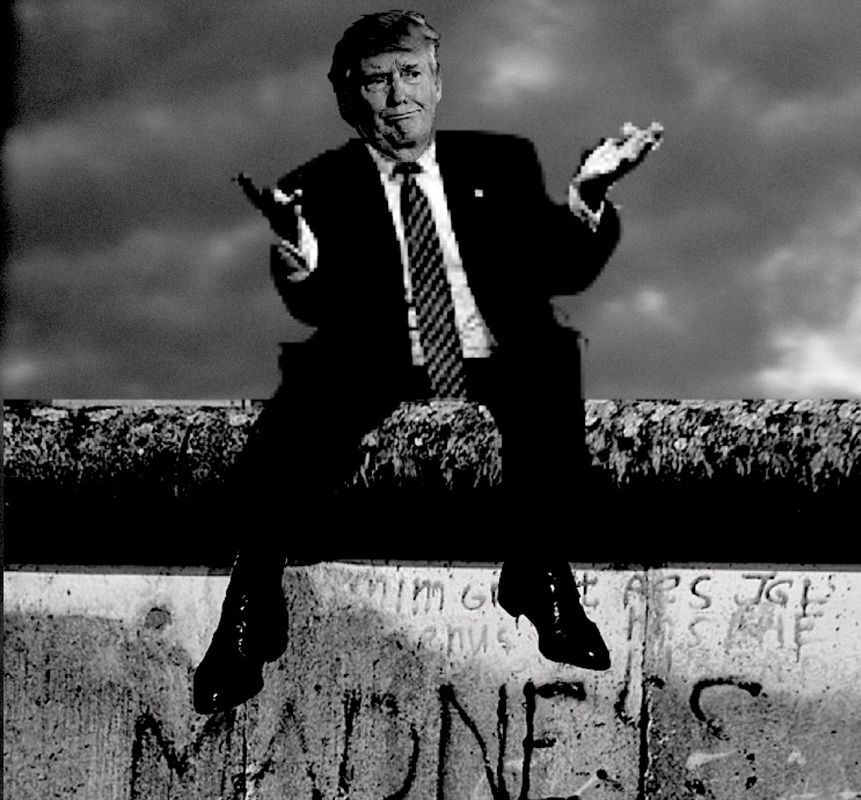
Now, in 2016, Donald Trump, the Republican frontrunner, has exploited the American people’s misdirected anger, by proposing the construction of a wall, abutting the border between the United States and Mexico. Trump’s proposal bears a striking resemblance to the original proposition for the construction of the Berlin Wall. 

The construction of the Berlin Wall was primarily proposed as a solution to halt mass emigration from East Germany into West Germany. Similarly, Trump’s proposal was presented as a “resolution” to address illegal immigration from Mexico into the United States. This uncanny parallel between Trump’s proposal and the East German, or the German Socialist Unity Party’s, proposal to construct the Berlin Wall provides evidence for the inherent repercussions that come with an abrupt decision to separate two territories. 

Furthermore, the support Trump has gained over the past few months exemplifies the danger of repetition as a result of ignorance. Once events like the construction of the Berlin Wall and the long-lasting effects of its establishment are forgotten, such events are more likely to be repeated.

In addition, Trump’s proposal promotes isolationism and separation, which has proven to be catastrophic. The economic consequences of creating a wall along the border include the restriction of trade imports and exports between the United States and Mexico and the cost of construction and maintenance of the wall. As well as the previously stated economic consequences of building Trump’s proposed wall, the deportation of undocumented immigrants that Trump has proposed in conjunction with the construction of such a wall would prove to be equally, if not more, detrimental to the U.S. economy. Combined with the deportation of undocumented immigrants, America would lose an estimated 11 million workers and consumers, resulting in a six percent decrease in the overall American GDP, or a $1.6 trillion decline.

Throughout his presidential campaign, Trump has focused on the proposed wall as a means to eliminate illegal immigration in favor of legal immigration. However, if Trump’s intentions were at all sincere, his campaign would be focused primarily on making legal immigration easier and granting a more accessible path to citizenship for undocumented immigrants. Instead, Trump has proposed to physically hinder and prevent immigration through constructing a wall along the border and deporting undocumented immigrants. 

Overall, Trump’s proposal to build a wall bordering the United States and Mexico resembles the original proposal to construct the infamous Berlin Wall, promotes xenophobic and isolationist practices, and exploits the fear of the American people, showing the terrifying reality of the power of anger over knowledge.

​ZWG
0 Comments
Forward>>

Copyright © 2016 Blogometry. All rights reserved.

  • Home
  • Quotes
  • Statistics